Oral Microbiome Evolution
The Lewis Working Group has made significant contributions to the study of human oral microbiome evolution. We work on numerous research projects using dental calculus (calcified dental plaque or tartar) as a source of ancient biomolecules such as DNA, proteins, and metabolites, with the aim of studying oral microbiome as well as oral pathogen evolution.
The Lewis Working Group has made significant contributions to the study of human oral microbiome evolution. We work on numerous research projects using dental calculus (calcified dental plaque or tartar) as a source of ancient biomolecules such as DNA, proteins, and metabolites, with the aim of studying oral microbiome as well as oral pathogen evolution.
|
Recovering ancient human mitogenomes from dental calculus
In 2016, I was part of the team that published the first complete human mitochondrial genomes reconstructed from archaeological dental calculus samples (Ozga et al. 2016). In this study, we recovered complete mitogenomes for six individuals from the 700-year old Norris Farms cemetery in Illinois. We used ancient DNA extracted from dental calculus in conjunction with target enrichment and next-generation sequencing methods. Our study showed that dental calculus is a viable alternative source of human DNA that can be used to reconstruct full mitogenomes from archaeological remains, especially in cases where conventional samples, such as bone, are not available or are not sufficiently well-preserved for ancient DNA analyses. |
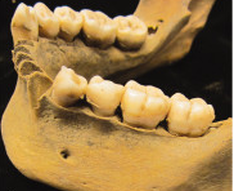
Dental calculus deposits on mandibular dentition (Ozga et al. 2016)
|
Oral pathogen evolution
Currently, I am working on a project called "CHOMPER: Calculus and Hominid Oral Metagenomes for Pathogen Evolution Research" for which Dr. Lewis and I were awarded a grant from the National Science Foundation (NSF). This project is in collaboration with Dr. Cara Monroe and Dr. Marc Levine (OU), Dr. Anne Stone and Dr. Brenda Baker (ASU), Dr. Keith Prufer (University of New Mexico), and Dr. Andrew Ozga (Nova Southeastern University).
The CHOMPER project aims to study how the genomes of oral disease-causing bacteria differ depending on host species, geographic location, time, and dietary lifestyle. We are using dental calculus samples from nonhuman primates, such as chimpanzees, gorillas, and orangutans, from museums in the U.S., and from archaeological human remains from sites in the Americas and Africa. These ancient human populations span a period of nearly 10,000 years and encompass the transition of humans from a forager to agricultural lifestyle. Using cutting-edge ancient DNA techniques, we are reconstructing the genomes of oral pathogens to answer questions regarding strain diversity, biogeography, genome structure, and the presence of genes associated with virulence and antibiotic resistance.
Currently, I am working on a project called "CHOMPER: Calculus and Hominid Oral Metagenomes for Pathogen Evolution Research" for which Dr. Lewis and I were awarded a grant from the National Science Foundation (NSF). This project is in collaboration with Dr. Cara Monroe and Dr. Marc Levine (OU), Dr. Anne Stone and Dr. Brenda Baker (ASU), Dr. Keith Prufer (University of New Mexico), and Dr. Andrew Ozga (Nova Southeastern University).
The CHOMPER project aims to study how the genomes of oral disease-causing bacteria differ depending on host species, geographic location, time, and dietary lifestyle. We are using dental calculus samples from nonhuman primates, such as chimpanzees, gorillas, and orangutans, from museums in the U.S., and from archaeological human remains from sites in the Americas and Africa. These ancient human populations span a period of nearly 10,000 years and encompass the transition of humans from a forager to agricultural lifestyle. Using cutting-edge ancient DNA techniques, we are reconstructing the genomes of oral pathogens to answer questions regarding strain diversity, biogeography, genome structure, and the presence of genes associated with virulence and antibiotic resistance.